Case Study
From Generic Coaching Site to a Niche That Actually Converts
Ron Gilliland spent 26 years coaching business owners behind a one-page site that said almost nothing. We rebuilt it around a single audience — builders and trade business owners — and gave the positioning a website that finally matches it.
Ron Gilliland has spent twenty-six years coaching business owners. He’s a Certified Professional Co-Active Coach (CPCC) with training in organizational development and Prosci’s ADKAR change framework — and a path that started toward marriage and family therapy before he realized those same tools solve business problems.
But for years his website didn’t say any of that, and worse, it didn’t say who he was for.
When Ron first came to us, SoloBusiness.coach was a single page with almost no content. No service breakdowns. No pricing. No clear way for a prospect to understand what Ron does, why he’s different, or how to take the next step. It was a digital business card — a thin one.
The Real Problem Wasn’t the Page Count
We built him a proper site. It was faster, deeper, better organized. It also aimed at “solo entrepreneurs,” which is less an audience than a category.
That’s the part worth being honest about: a good website pointed at a vague audience is still a vague website. Ron’s best conversations, the ones where the work actually landed, kept coming from the same kind of person — a builder or trade business owner who had grown a real company and was still the one answering every phone call at 6am.
So we rebuilt around that. New domain. New name. New positioning.
The Repositioning: Get Off the Tools
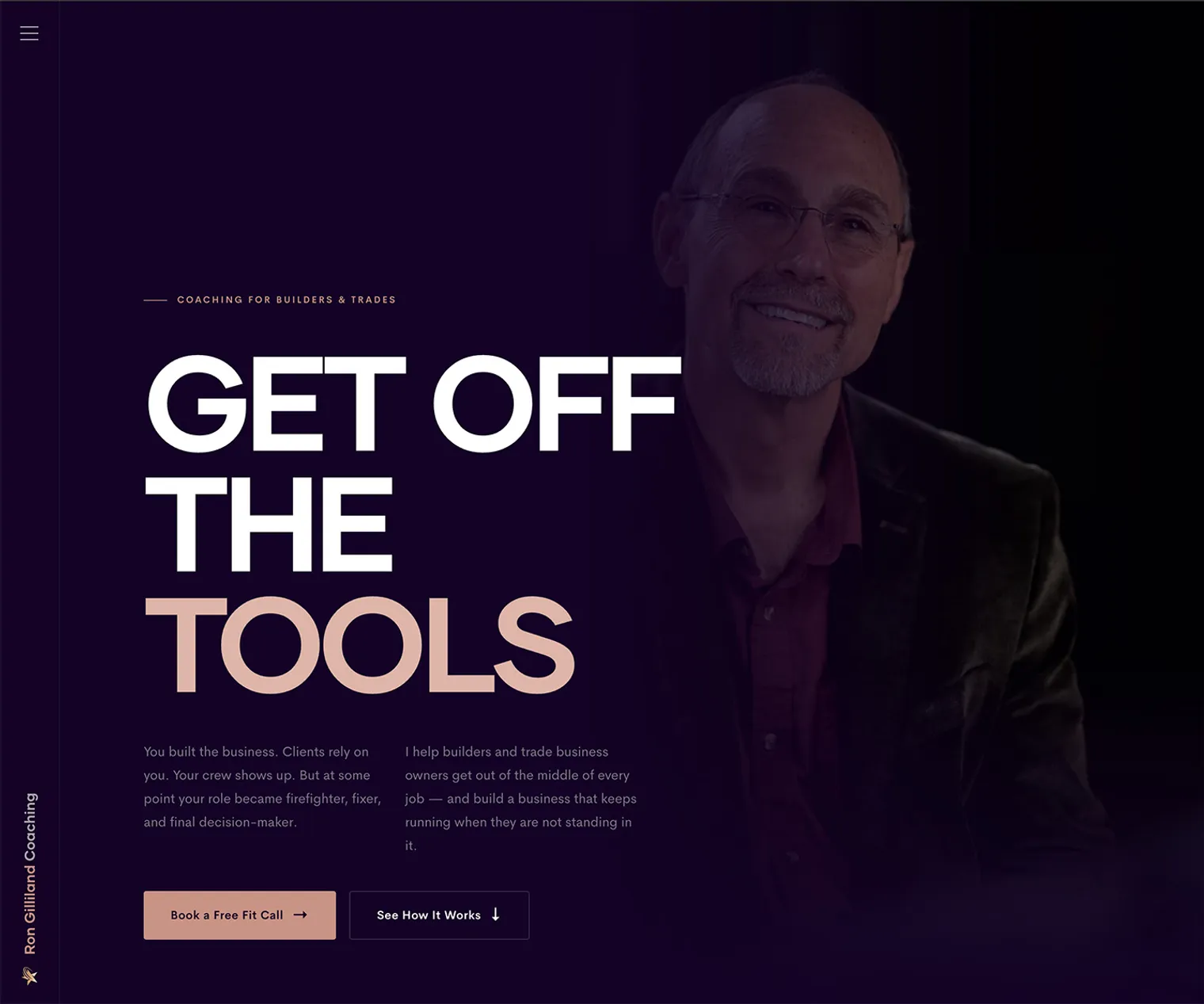
RonGillilandCoaching.com opens with three words that do more qualifying work than a page of copy: Get Off the Tools.
If you’re a builder, you know exactly what that means and whether it’s your problem. If you’re not, you self-select out — which is the point. Narrow positioning doesn’t shrink a coaching practice; it makes the right prospect stop scrolling.
The supporting copy names the trap directly: “You built the business. Clients rely on you. Your crew shows up. But at some point your role became firefighter, fixer, and final decision-maker.”
Design That Reads Like the Audience
We moved away from bright and generic to something darker and more editorial — deep plum, heavy sans-serif display type, a full-bleed portrait, and a lot of quiet space. It reads closer to a trade publication than a coaching site, which is deliberate. The people Ron wants have a well-tuned instinct for anything that feels like a pitch deck.
Five Focus Areas Instead of Vague Service Blocks
The old site described coaching in abstractions. The new one names the work in the owner’s own language:
- Get Off the Tools — find where you are the bottleneck and define the work that actually belongs to you
- Delegate So the Crew Develops — hand off work in a way that builds leads who make the call you would have made
- Pricing & Positioning — know what you bid, what you turn down, and which work is quietly costing you money
- Sustainable Owner Workload — build a week you can hold for twenty years, not one you survive
- Systems That Hold Under Load — scheduling, handoffs, and job close-out that don’t break the moment you grow
Every one of those is a searchable problem, and every one of them earns its own indexable section.
A Story That Earns the Positioning
Ron’s father, Glenn “Bud” Gilliland, was a master mechanic and shop foreman who spent an entire career on the tools without ever building systems that ran without him. That’s now a section on the site — not decoration, but the credibility bridge. Ron hasn’t run a trade business himself, and the site says so plainly, then answers the objection head-on in the FAQ: “Have you actually done this kind of work?”
Naming the obvious objection before the prospect does is worth more than another paragraph of credentials.
Pricing You Can Read Without a Call
Three intensives, $295 each, two sessions apiece — Get Out of Your Own Way, Escape the Owner’s Trap, and One Smart Move — plus a free 20-minute fit call. No “contact us for pricing.” Builders price work for a living; they trust people who do the same.
Built for Search and for AI Answers
The FAQ isn’t filler. Each question is phrased the way an owner would actually type or say it:
- “How do I get off the tools without losing money?”
- “My crew calls me for everything. How do I stop that?”
- “I do not have time for coaching. That is the whole problem.”
Those are long-tail queries and they’re also exactly the shape of question people now ask AI assistants. Structured, directly answered content is what gets quoted back.
Performance
The site is a static SmartSite build on Astro — no WordPress, no plugin stack, no theme overhead — and it scores nearly perfect 100s across all four Google PageSpeed Insights categories. That’s not vanity. Pages ship as clean HTML with images optimized at build time, which is the difference between a site that loads instantly on a phone in a job trailer and one that doesn’t.
Why This Matters
Ron works from overseas now, with clients scattered across the world. His site isn’t fighting for a local map pack — it’s fighting to be the obvious answer when a builder anywhere types “how do I get off the tools” at 9pm.
That makes the positioning do double duty. A coach without a geography can’t lean on “local business coach near me” to bring people in; the site has to be findable on the problem itself. Narrowing to builders and trades is what makes that possible — it’s a specific enough phrase to own, and broad enough to exist in every market Ron’s clients are in.
A one-page site couldn’t do that. Neither could a well-built site aimed at everyone. The rebrand traded reach for precision, and precision is what turns a website into a pipeline.
What We’re Watching
The new domain is starting from zero authority, so the honest expectation is a ramp, not a spike — indexing first, then long-tail rankings on the focus-area and FAQ pages, then fit-call bookings. We’ll be tracking which of the five focus areas pulls traffic, because that tells Ron where the demand actually is.
If your website is aimed at “anyone who needs what I do,” it’s aimed at no one. That was the real fix here, and it’s the one we see service businesses avoid the longest.
Ready to build a site that works as hard as you do? Let’s talk.